
Patent valuation
How can the economic value of a patent be determined within the valuation of industrial property assets?

Introduction : From Legal Protection to Economic Value
A patent is often perceived as the result of a research effort, the legal embodiment of an invention and, sometimes, as a guarantee of value. You could say that “A Patent is never good for what it protects, but for what it allows you to exploit ”. However, between obtaining an industrial property title and the effective creation of wealth, there are many factors of uncertainty. Legal protection, as solid as it may be, prejudges neither industrial feasibility, nor market adoption, nor the company's ability to transform an exclusive right into sustainable economic flows.
The evaluation of a patent is precisely aimed at bridging this gap between law and economics. It consists in determining, at a given date, the value of an intangible asset whose existence is legal, but whose substance is fundamentally economic. This exercise takes place in various contexts — transfer, licensing, financing, restructuring, litigation or taxation — and requires the translation of technical, strategic and legal elements into coherent financial hypotheses.
The central difficulty lies in the very nature of the patent. It does not generate revenue by itself. Its value depends on its real or potential exploitation, its level of maturity, the solidity of its protection and its integration into a given competitive environment. Therefore, one question remains: How to evaluate a patent rigorously, without overvaluing a legal title or underestimating a potential that is still under construction?
Conceptual Framework and Economic Rationale for Patent Valuation
A. Why Value a Patent? Objectives, Uses and Contexts
The purpose of evaluating a patent is to determine the economic value of an industrial property right at a given date, in a specific context and for a specific use. Unlike a tangible asset, a patent does not generate cash flow by itself. Its value results from its ability to protect, support or secure future income from the exploitation of a technology, directly or indirectly, by its owner or by a third party.
In practice, the evaluation of a patent occurs in a variety of situations, in particular when:
- transfer transactions
- licensing
- fundraising
- restructuring
- contributions in kind
- disputes and tax or accounting issues.
In each of these contexts, the value selected must be consistent with the purpose of the evaluation, the scope analyzed and the underlying economic hypotheses.
In addition to regulatory or transactional compliance, patent evaluation is also a strategic decision-making tool. It makes it possible to assess the real economic weight of an intangible asset within a technological portfolio, to guide research and development investment choices, or to structure a licensing policy. The evaluation exercise thus contributes to the transformation of legal law into an economic management instrument.
B. Specificities of the Swiss Patent Valuation Framework
In Switzerland, patent valuation is part of a legal and economic framework that does not prescribe a specific method. The practice is based on the application of recognized valuation methods, implemented consistently and adapted to the specific characteristics of the asset being valued. The focus is less on the method chosen than on the soundness of economic reasoning, the traceability of assumptions and the ability of the valuation to reflect the substance of the asset.
Swiss practice attaches particular importance to the underlying economic reality. The value of a patent does not derive from its legal existence alone, but from its operational potential, its level of technological maturity, the scope and robustness of its protection, as well as from its registration in an identifiable market. This approach involves a close relationship between the legal analysis of the title, the technical assessment of the invention and the financial modeling of expected flows.
In fiscal and accounting contexts, valuations are generally constructed in a logic of caution and comparability. Market references, in particular royalty rates observed by sector, are useful comparative elements, without being prescriptive in nature. Their use requires interpretation and adjustments taking into account the specificities of the patent in question, in particular in terms of scope, geography, duration and risk profile.
Finally, Swiss practice favors proportionate and defensible valuations. The objective is not to determine a maximum theoretical value, but to adopt an estimate that is economically justified, consistent with the intended use of the asset and likely to withstand critical examination, whether fiscal, judicial or transactional.
Structure of a Patent Valuation Report and Methodological Approaches
A. The Patent Valuation Report: Scope, Logic and Credibility
The purpose of a patent valuation report is to present in a structured, coherent and documented manner the reasoning that led to the determination of the value of an industrial property asset. It is not only a financial modeling exercise, but a transversal analysis integrating legal, technical, economic and strategic dimensions. The credibility of the report is based on the clarity of the scope analyzed, the justification of the assumptions used and the ability of the evaluation to reflect the economic reality of the patent in question.
1. Company Overview
The company presentation is the starting point for the report. It aims to place the diploma in its organizational and strategic environment. This section describes the company's core business, business model, competitive position, and role in the value chain. The objective is not to produce an exhaustive analysis of the company, but to identify the relevant elements to understand the economic function of the patent, its degree of integration into operational activity and its strategic or ancillary nature.
2. Market Overview
Market analysis makes it possible to contextualize the intangible asset in an identifiable economic environment. It focuses on the sector of activity concerned, its growth dynamics, its level of maturity and its barriers to entry. This section also aims to assess the role of protected technology in the market, in particular in terms of differentiation, substitutability and competitive intensity. The market overview contributes to the assessment of the economic potential of the patent and to the assessment of its capacity to generate sustainable future flows.
3. Qualitative assessment of the patent
The qualitative assessment of the patent is a central step in the valuation report. It aims to analyze the intrinsic and extrinsic quality of the asset, independently of any financial modeling. This analysis focuses in particular on the legal scope of the protection conferred by the patent, the clarity and extent of the claims, and their robustness in the face of risks of circumvention or contestation.
The geographical scope of protection is also examined, taking into account the territories covered, their economic importance and the residual duration of the rights. The evaluation also includes an assessment of the intrinsic value of the patent, linked to the technical solidity of the invention and its differentiating nature, as well as an extrinsic value, resulting from its competitive environment, its industrial integration and its potential for commercial exploitation.
This qualitative analysis can be synthesized in the form of a structured scoring, reflecting the strengths and weaknesses of the patent according to predefined criteria. Identifying technological keywords and fields of application helps to specify the economic scope of the asset and to facilitate subsequent comparisons with market references.
4. Patent valuation methodology and approach
The evaluation methodology used is generally based on a combination of several approaches in order to combine the results and strengthen their coherence.
- The cost approach consists in estimating the value of the patent based on the investments required to create or rebuild it. It may be based on historical costs incurred or on an estimate of reconstitution or replacement costs. This approach is particularly relevant for patents at an early stage of development, although it alone does not capture the future economic potential of the asset.
- The market approach is based on the analysis of comparable transactions involving patents or similar technologies. It aims to identify observable references that allow valuation to be anchored in market practices. However, the rarity and heterogeneity of available transactions require careful interpretation and significant adjustments to take into account differences in scope, maturity and contractual conditions.
- The revenue approach is generally the core of the evaluation of exploited or exploitable patents. It is based on the estimation of economic flows attributable to the asset, often using the royalty method. This method can be applied according to various logics. It can be based on observed sectoral royalty rates, used as aggregate benchmarks. It can also be based on rates from a panel of comparable patents or licenses, when sufficiently relevant data is available. And finally, on the Company's intrinsic royalty rate, based on a formula derived from Black-Scholes-Merton. A useful approach when industry or market royalty rates are unavailable.
- In addition to revenue approaches, the real options approach makes it possible to explicitly model the managerial flexibility and uncertainty associated with patent development and exploitation. It is based in particular on the Black-Scholes-Merton models and on the Cox-Ross-Rubinstein binomial model. This approach does not replace the royalty method, but is an analytical extension of it, insofar as it also aims to express the future economic value of the patent, while integrating the possibility of adapting the exploitation strategy over time.
5. Appendices, Assumptions and Data Sources
The annexes to the report contain all the documentary elements that served as the basis for the evaluation. In particular, they include legal, technical, and economic sources, the market references used, and detailed assumptions and supporting calculations. Sectoral data, such as observed royalty rates, are presented in an aggregated and interpreted form, in order to ensure the traceability of reasoning while respecting the confidentiality and use constraints of professional sources.
Market Sources and Reference Data for Patent Valuation
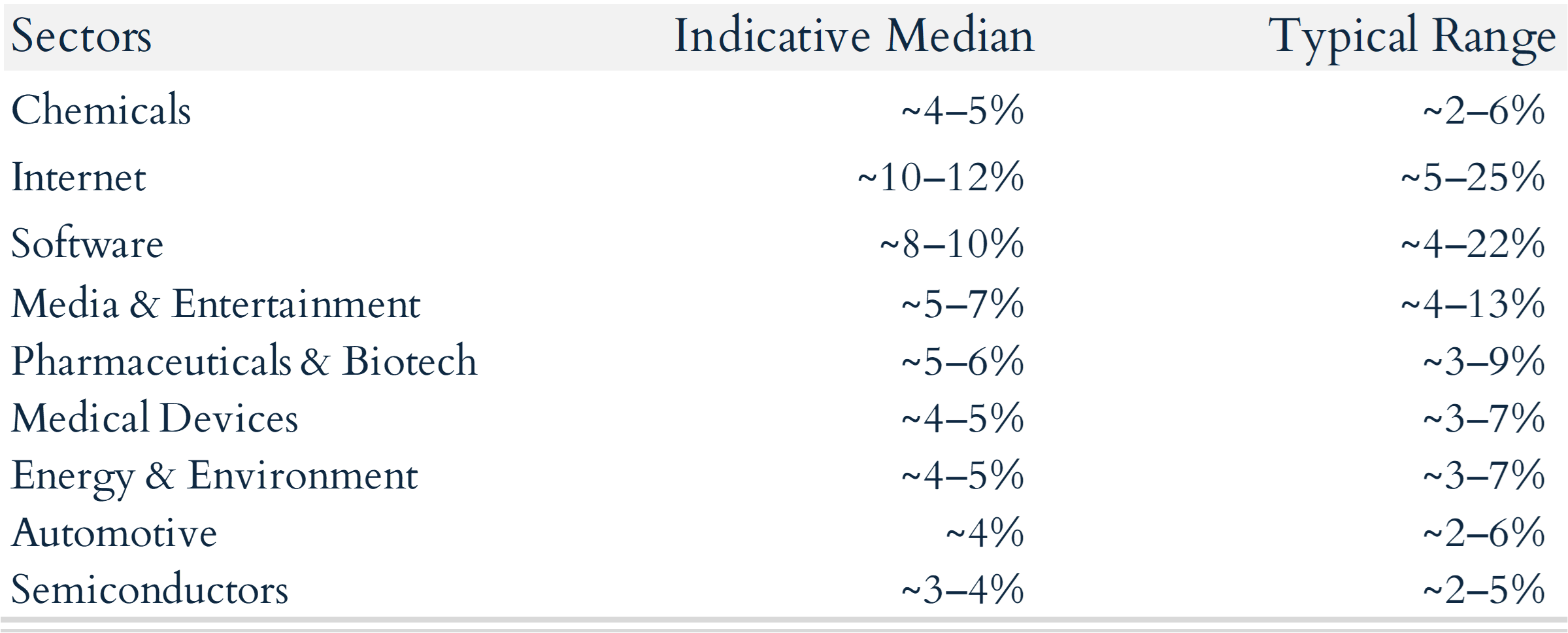
A. Sector-Based Royalty Rate Benchmarks (2024)
Sectoral royalty rate tables are a central reference source in the context of the economic valuation of patents, in particular when using the royalty method. They make it possible to anchor the evaluator's reasoning in practices observed on the market, by providing orders of magnitude from license agreements actually negotiated. In 2024, these data remain an essential point of support for assessing the consistency of the hypotheses adopted, without however being a substitute for a specific analysis of the patent being evaluated.
The rates presented by sector are the result of aggregated analyses based on a large set of technology license agreements observed over a long period of time. They are generally expressed as a percentage of turnover or an equivalent economic base, and presented in the form of descriptive statistics, such as the average, median, and quarterles. This approach makes it possible to reflect the dispersion of market practices and to limit the influence of atypical or extreme situations.
As part of a patent valuation report, these tables are used as comparative benchmarks. They make it possible to identify rate intervals compatible with the sector of activity concerned and the type of technology protected. However, their use requires careful interpretation, taking into account in particular the maturity level of the patent, the scope of protection, the geography covered, the residual duration of the rights and the risk profile associated with the exploitation of the asset.
To ensure the robustness and defense of the assessment, sectoral royalty rates are presented in an aggregated, restated, and anonymized form. They are neither automatic standards nor contractual recommendations, but rather comparative elements intended to inform the professional judgment of the evaluator. The objective is not to replicate an observed rate mechanically, but to locate the rate selected within an economically coherent and methodologically justified market framework.
Words from the manager : Executive Statement – The Economic Value of a Patent
The evaluation of a patent is never limited to the mechanical application of a method or to the selection of a rate based on market references. It is based on a detailed understanding of the asset, its technological environment and its economic trajectory. Above all, a patent is a conditional right, whose value depends on its ability to be exploited, defended and integrated into a coherent value creation strategy.
In this context, the role of the evaluator consists in combining methodological rigor and professional judgment. Market data, financial models, and legal frameworks are indispensable tools, but they never replace critical analysis of the specific characteristics of each patent. It is this ability to contextualize the asset, to appreciate its risks and value drivers, that bases the credibility and defense of valuation.
Key Takeaways – Core Principles of Patent Valuation
Patent evaluation is at the crossroads of law, technology and finance. It involves a structured approach, based on recognized methodologies, but flexible enough to take into account the specific characteristics of the asset and its economic environment. No single indicator, whether it's a sectoral royalty rate or an advanced financial model, can summarize the value of a patent by itself.
Market references and sectoral analyses are essential references to anchor the evaluation in economic reality. However, their use requires careful interpretation and appropriate reprocessing, in order to reflect the maturity level, the scope of protection and the risk profile of the patent being evaluated.
The objective is not to produce a maximum theoretical value, but to adopt an estimate that is economically justified, consistent with the intended use of the asset and defensible in the face of critical examination.
Ultimately, the value of a patent lies not only in the legal title it confers, but in the company's ability to transform this right into a sustainable economic advantage. Evaluation is thus a tool for reading and managing, in the service of informed strategic decisions, rather than a simple numerical purpose.
In this context, mastering patent valuation methods is a strategic challenge for managers, financial managers, lawyers and investment professionals facing decisions involving industrial property assets. Understanding methodological approaches, market sources, and value creation mechanisms is essential to produce valuations that are economically relevant and defensible.
For people wishing to deepen these issues, Hectelion offers training dedicated to patent valuation, covering the conceptual framework, valuation methods and their practical implementation. Information about this training is available at the following address:
Professional Training – Mastering Patent Valuation
👉 Hectelion offers a patent valuation training program.
Author
Aristide Ruot, Ph.D
Founder | Managing director