
TRL and MRL: Integrating Technological Maturity into the WACC
Should TRL and MRL be incorporated into the discount rate?

Introduction: Why TRL and MRL Have Become Essential in Valuation
It is often said that “technology only has value when it meets the market.”
Yet this encounter is far from immediate. Between the initial idea and a marketable product, between research and commercialization, lie several years of uncertainty, prototypes, technical validations, and industrial testing.
This is where the concepts of Technology Readiness Level (TRL) and Manufacturing Readiness Level (MRL) come into play, as indicators of the technological and industrial maturity of an asset.
The question therefore arises: when determining the discount rate used in the valuation of an intangible asset, should a specific adjustment be made to reflect these maturity levels?
TRL (Technology Readiness Level): Measuring Technological Risk in Financial Valuation
The Technology Readiness Level (TRL) is a structuring indicator used to assess the level of technological maturity of an innovative asset or a start-up. Initially developed in the aerospace and defense sectors, it is now widely applied in financial valuation to objectify technological risk, which is often difficult to quantify using traditional methods.
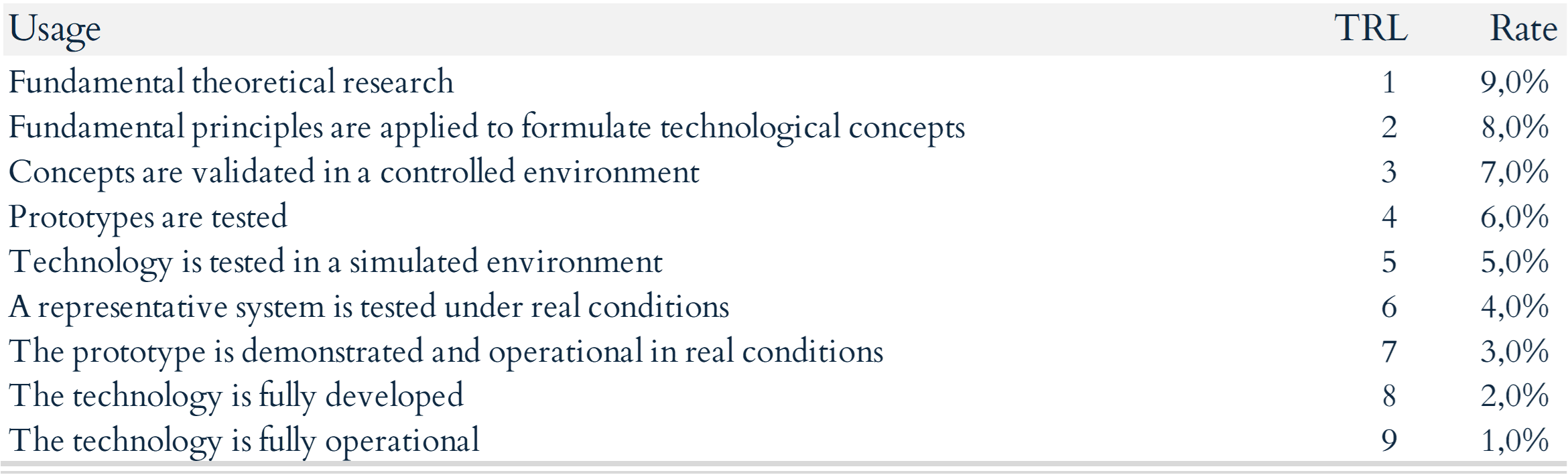
TRL classifies a technology along a progressive scale ranging from fundamental research to a fully operational and proven solution in real-world conditions.
From a financial perspective, the lower the TRL, the higher the probability of technological failure, development delays, or challenges to the business model. In practice, this uncertainty translates into additional risk, comparable to an incremental risk premium applied to the WACC, or into a more conservative weighting of future cash flow scenarios.
Conversely, a high TRL reduces technological uncertainty and allows the valuation to gradually align with more standard market assumptions. TRL therefore represents a key methodological discipline, enabling a coherent link between a project’s technical maturity and its financial assumptions.
MRL (Manufacturing Readiness Level): Integrating Industrial and Execution Risk
The Manufacturing Readiness Level (MRL) complements the TRL analysis by assessing a project’s ability to be industrialized and produced at scale. While TRL focuses on technological feasibility, MRL evaluates the robustness of manufacturing processes, supply chain control, unit costs, and industrial reproducibility.
In financial valuation, MRL is critical because a technologically mature solution may remain economically unviable if its production is not under control.
A low MRL implies significant risks of cost overruns, delays, additional CAPEX requirements, or difficulties in ramping up production, all of which directly affect projected cash flows. These industrial risks are generally incorporated either through a specific adjustment to the discount rate or, more robustly, through weighted scenarios reflecting a progressive deployment of production capacity.
By contrast, a high MRL indicates a proven ability to produce reliably and competitively, substantially reducing execution risk and allowing for a gradual normalization of financial assumptions. MRL thus becomes an essential lever for linking industrial reality with economic valuation requirements.

TRL, MRL and Risk: A Necessary Weighting
Yes—because TRL and MRL reflect a measurable reality of risk.
An asset at an early research stage does not share the same risk profile as a technology that has already been industrialized.
Integrating these indicators into the discount rate therefore makes it possible to weight value according to maturity, reflecting the distance between concept and market.
In practice, a technology with a low TRL (for example, TRL 3 or 4) carries a high risk of non-completion, justifying an additional premium in the cost of capital. Conversely, an asset with a TRL or MRL close to 9 is often ready for exploitation and may justify a more moderate discount rate.
This approach makes valuation more consistent with the asset’s actual stage of development.
When TRL and MRL Complicate Rather Than Clarify Valuation
However, systematically incorporating a TRL/MRL adjustment into the discount rate can raise issues.
First, while useful, these indicators remain partly qualitative and depend on the evaluator’s judgment. They vary across interpretations, industries, and applied standards.
Second, their impact may overlap with other components of the cost of capital, such as technological risk, market risk, or specific premiums applied to immature intangible assets. In other words, introducing a TRL/MRL correction can sometimes mean adding uncertainty on top of uncertainty.
Finally, certain technologies may exhibit a low TRL while benefiting from strong disruptive potential or significant institutional support (strategic patents, public funding programs, industrial consortia), which may reduce the need for an excessive risk premium.
The rates associated with TRL and MRL levels should not be added mechanically.
They are risk indicators intended to guide the adjustment of the discount rate or the weighting of valuation scenarios.
TRL, MRL and Start-up Valuation
In the context of start-ups:
- TRL affects the probability of market access;
- MRL influences growth speed and CAPEX requirements.
In practice, TRL and MRL help reconcile technical narratives with financial discipline during fundraising processes.
Common Mistakes to Avoid
- Assuming that a high TRL implies the absence of risk;
- Completely ignoring MRL;
- Adjusting the WACC without technical justification;
- Using TRL/MRL as marketing arguments without financial analysis.
Management Perspective
The valuation of an intangible asset is never reduced to a formula.
It relies on a delicate balance between numerical rigor and an intuitive understanding of the project’s true maturity. TRL and MRL do not tell the whole story, but they direct attention to the essential question: how ready is this technology to stand on its own?
Conclusion: TRL and MRL as Tools of Financial Discipline
TRL and MRL levels provide valuable insight into an asset’s maturity.
Yes, taking them into account when determining the discount rate enhances the accuracy of economic reasoning by aligning risk with the stage of development.
But no, they should not become an automatic or mechanical adjustment factor.
The most appropriate approach is to translate technological maturity not through a single premium, but through an integrated view:
- TRL/MRL illuminate the risk profile;
- the discount rate expresses it in financial terms;
- and the valuation narrative connects the two by contextualizing each parameter.
Ultimately, maturity is not a data point—it is an interpretation.
The evaluator’s role is not to penalize a technology for its youth, but to understand how much of its potential is still under construction, and to reflect that honestly in the rate applied.
Author
Aristide Ruot, Ph.D.
Founder | Chief Executive Officer