
Startup valuation
How do you evaluate the economic value of a company whose growth model remains uncertain and whose future cash flows have yet to be established?

Introduction | Startup Valuation: A Rigorous Framework for Valuing Uncertainty
Startups are often perceived as vehicles of future value rather than sources of immediate economic returns. They embody innovation, rapid growth ambitions, and the promise of transforming ideas into scalable businesses. Yet behind this compelling narrative lies one of the most complex exercises in corporate finance: startup valuation.
Unlike mature companies, startups cannot be valued on the basis of stabilized cash flows or fully reliable market benchmarks. Their valuation is not grounded in historical performance, but in forward-looking trajectories that are still under construction, shaped by uncertainty, strategic choices, and execution risk.
This reality is often summarized by a well-known adage:
“A startup is not worth what it is today, but what it may become.”
While frequently used to justify high valuations, this statement highlights the core difficulty of the exercise: translating uncertain potential into an economically coherent and defensible value, without confusing ambition with actual value creation.
Startup valuation therefore consists in estimating, at a given point in time, the value of an entrepreneurial project whose economic substance remains largely prospective. It arises in multiple contexts — fundraising, investor entry, portfolio structuring, corporate reorganization, or litigation — and requires a combination of strategic analysis, business model understanding, and financial discipline.
This article proposes a structured and rigorous framework to address the following question:
How can a startup be valued rigorously, without relying on fragile financial mechanics or overvaluations driven by market hype and imperfect comparables?
To answer this, we first clarify the economic definition of a startup, then review the main valuation approaches used in practice. We subsequently address the specific challenges of valuing a portfolio of startups, before concluding with key takeaways and inherent limitations.
Economic Framework and Definition of a Startup
A. A Financial, Not a Marketing Definition
In everyday language, the term startup is often used broadly to describe any innovative or technology-driven company, typically associated with youth, rapid growth, and fundraising activity. However, this definition is insufficient from a financial valuation perspective.
From an economic standpoint, a startup is defined primarily by the degree of uncertainty surrounding its ability to generate sustainable future cash flows. Neither the age of the company, its legal form, nor its sector alone is sufficient to qualify it as a startup in valuation terms.
A startup is characterized by:
- A business model still undergoing validation,
- Uncertain commercial traction,
- An evolving cost structure,
- Unproven scalability,
- Competitive advantages that are not yet fully established.
As emphasized in valuation literature — notably by Aswath Damodaran — the distinction between startups and established companies lies not in size or profitability, but in the visibility, predictability, and robustness of future cash flows.
B. Revenue and Profitability: Misleading Indicators of Maturity
A frequent misconception in startup valuation is the reliance on accounting indicators such as revenue or EBITDA as proxies for maturity.
C. Revenue: Existence vs. Quality
The presence of revenue does not imply economic maturity. Startup revenue may stem from:
- Pilot projects or proofs of concept,
- Non-recurring contracts,
- Aggressive or experimental pricing strategies,
- A highly concentrated customer base,
- Acquisition channels that are not yet scalable.
From a valuation perspective, the key question is not whether revenue exists, but whether it is recurring, scalable, and economically sustainable.
D. Positive EBITDA Does Not Eliminate Startup Risk
A startup with positive EBITDA may still qualify as a startup in economic terms. Profitability may be:
- Temporary or cyclical,
- Achieved through underinvestment,
- Offset by future capital expenditure needs,
- Accompanied by negative cash flows due to working capital or growth investments.
EBITDA does not capture structural fragilities such as competitive pressure, regulatory risk, technological obsolescence, or platform dependency. What matters is the stability and predictability of the business model, not a single accounting outcome.
E. Uncertainty and Strategic Optionality
Uncertainty is a defining feature of startups. It affects demand, execution capability, competitive dynamics, and long-term viability. Importantly, uncertainty is not purely negative — it is often the source of upside potential.
Startups also embed significant managerial flexibility, including the ability to pivot, scale, abandon projects, or enter new markets. This flexibility creates strategic optionality, which is largely absent in mature businesses.
Valuation frameworks inspired by real options theory are particularly suited to capturing this dimension, by treating the startup as a set of conditional future decisions rather than a fixed cash-flow-generating asset.
F. Development Stages and Valuation Implications
Startup valuation must be adapted to the company’s stage of development:
- Pre-revenue stage: validated concept or technology, no material revenue,
- Early revenue stage: first revenues, limited visibility,
- Growth stage: accelerating revenue, profitability still uncertain,
- Scale-up stage: improving operational structure and economic visibility.
As maturity increases, uncertainty decreases — but never fully disappears. Valuation methods must therefore evolve with the company, rather than applying a single standardized framework.
Valuation Approaches and Methodologies
A. Limitations of Traditional Valuation Methods
Traditional methods such as Discounted Cash Flow (DCF) or public market comparables face structural limitations when applied to startups.
DCF models require long-term assumptions on growth, margins, and capital intensity that are often highly speculative for startups. Small changes in assumptions can lead to disproportionate valuation swings, reducing robustness.
Market multiples suffer from comparability issues. Observed valuations may reflect market conditions, liquidity cycles, or investor competition rather than underlying fundamentals.
These methods should therefore be used with caution and primarily as reference points, not as standalone valuation tools.
B. Venture Capital Method
The Venture Capital (VC) Method values a startup based on its estimated exit value, discounted by a required rate of return reflecting project risk and investor expectations.
While aligned with investor logic, this method is highly sensitive to assumptions regarding exit multiples, timing, and return targets, and requires strong justification.
C. Scenario-Based Valuation
Scenario-based valuation explicitly models uncertainty by defining multiple development paths (downside, base case, upside) with associated probabilities.
This approach captures the asymmetric payoff structure of startups and promotes transparency in assumptions, making it particularly suitable for negotiation and decision-making contexts.
D. Real Options Valuation
Real options models formalize strategic flexibility by valuing expansion, abandonment, or delay options embedded in startup projects.
Although more complex, these models offer a powerful framework to reflect the non-linear nature of startup value creation and are often used as analytical complements to other methods.
E. Market Benchmarks: Informative, Not Deterministic
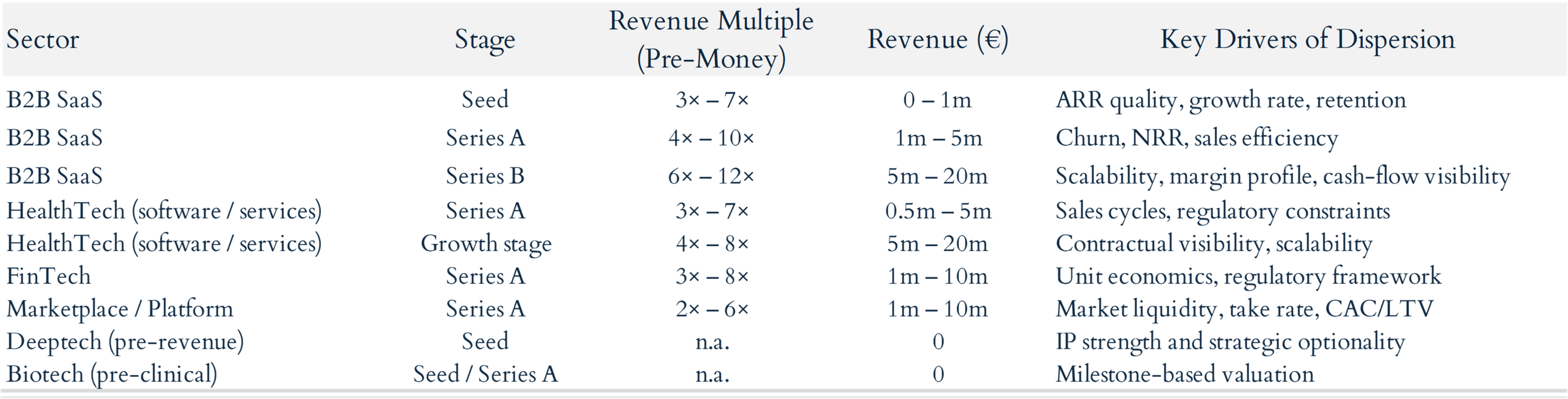
Transaction and fundraising data provide useful benchmarks but should not be applied mechanically. Valuation remains context-specific and must account for differences in maturity, business model, and risk profile.
F. Monte Carlo Simulation
Monte Carlo simulations generate distributions of possible outcomes by introducing probabilistic variability into key assumptions. This approach is particularly relevant for capturing risk dispersion and tail outcomes.
G. Narrative and Storytelling
Storytelling does not replace valuation models, but it influences the credibility of assumptions, scenario probabilities, and perceived risk. A coherent narrative enhances the economic consistency of valuation inputs.
H. Net Asset Value (NAV) and Asset-Based Approaches
While often irrelevant for startups due to the dominance of intangible assets, NAV may serve as a downside or liquidation reference in specific contexts.
I. Early-Stage Valuation Methods
Specific methods such as the First Chicago Method, Scorecard Method, Berkus Method, and Risk Factor Summation Method provide structured frameworks when financial data is limited, particularly at seed stages.
Valuing a Portfolio of Startups
Valuing a startup portfolio is not a simple aggregation exercise. It requires segmentation by stage, sector, and business model, and careful consideration of risk correlation, illiquidity, and concentration.
Portfolio valuation must integrate:
- Differentiated valuation methods,
- Book value reconciliation,
- Liquidity and concentration discounts,
- Probabilistic aggregation and scenario analysis.
Importantly, portfolio valuation is a dynamic management tool, supporting strategic allocation, reinvestment, and exit decisions.
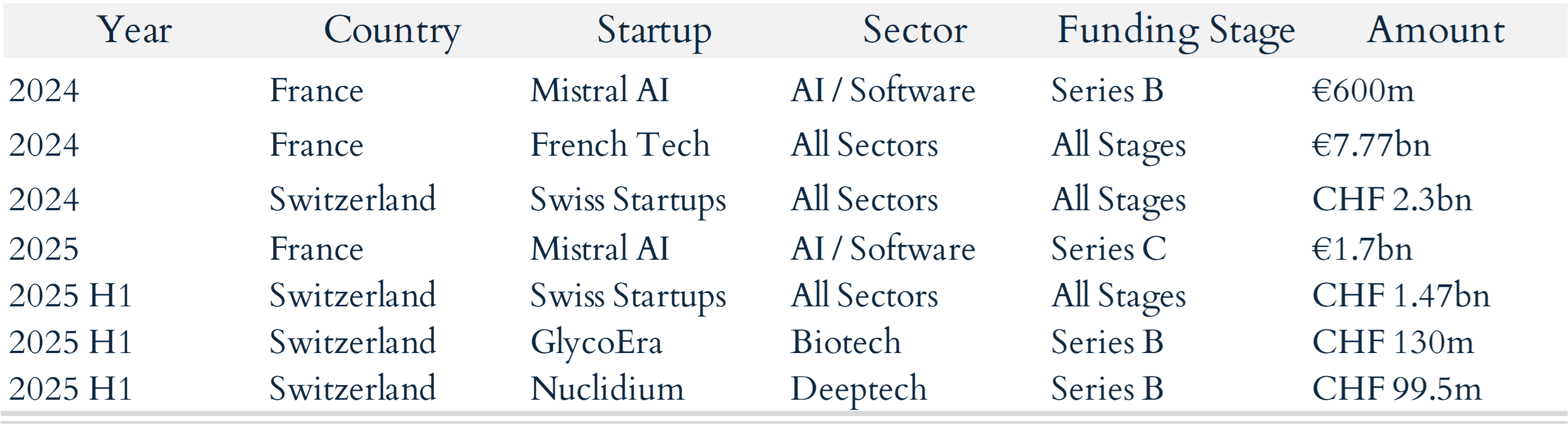
Fundraising Examples (France & Switzerland)
European Startup Valuation Benchmarks: Fundraising Revenue Multiples by Sector (2025)
Management Perspective
Valuing startups remains one of the most challenging exercises in corporate finance. It lies at the intersection of financial rigor, strategic judgment, and the projection of futures that are, by definition, uncertain.
Through this article, the objective was not to promote a universal formula or a simplified valuation shortcut. On the contrary, our aim was to reaffirm that valuation is прежде all a disciplined reasoning process — one that relies on explicit assumptions, economic coherence, and a clear understanding of risk.
In an environment where market sentiment, trend-driven comparisons, and promotional narratives can sometimes overshadow fundamental analysis, we believe it is essential to restore a structured and methodical approach to value. Valuing a startup, or a portfolio of startups, is not about predicting outcomes that no one can know with certainty. It is about organizing uncertainty, identifying the true drivers of value creation, and assessing risks with clarity and intellectual honesty.
This methodological discipline lies at the core of Hectelion’s practice. It guides both our valuation assignments and our advisory work alongside founders, investors, corporates, and institutions facing complex structuring or investment decisions.
We are convinced that a well-constructed valuation does not claim to define “what a company is worth” in absolute terms. Rather, it provides a coherent, well-founded, and defensible economic framework that supports informed decision-making in uncertain environments.
Conclusion: Valuation as a Decision-Making Tool
Startup valuation is not about predicting the future with certainty. It is about structuring uncertainty, identifying value drivers, and assessing risks in a disciplined and transparent manner.
No single method captures the full economic reality of a startup. Robust valuation emerges from the combination of complementary approaches, adapted to the company’s maturity and context.
At Hectelion, this disciplined methodology guides our valuation and advisory work, supporting founders, investors, and institutions in making informed and defensible strategic decisions.
Interested in Business Valuation Training?
Hectelion offers professional training in business valuation, combining theoretical frameworks, practical methodologies, and real-world case studies.
👉 Learn more about our valuation training programs
Author
Aristide Ruot, Ph.D.
Founder & Managing Director