
Company Sale Process | M&A
How can a company sale be structured to secure the transaction and preserve value through to closing?

Introduction: Selling a Company Is Never a Trivial Act
Selling a company is never a purely financial event. It is often the culmination of an entrepreneurial journey—the crystallization of years of decisions, risks taken, and value patiently built. Beyond the act of sale itself lie economic, strategic, and human considerations that go far beyond the sole question of price.
“A successful sale is not one that closes quickly, but one that has been prepared methodically.”
For many business owners, the sale of a company is still too often perceived as a bilateral negotiation between a seller and a buyer. This view is reductive. In reality, a sale transaction is a structured process, where sometimes divergent interests converge within a context of information asymmetry and time constraints. The central challenge is not merely finding a buyer, but organizing this encounter under secure, value-creating conditions.
The sale process is designed precisely to transform an intention to sell into a completed transaction, by reducing risk, structuring information, and maintaining positive momentum through to closing. It mobilizes multiple disciplines—strategy, finance, law, and negotiation—and requires methodological rigor at every stage.
This article provides a clear and structured overview of the company sale process as practiced in M&A. It outlines the key phases—preparation, marketing, due diligence, negotiation, and completion—highlighting the objectives, challenges, and indicative timeline of each, to help business owners view a sale not as a single event, but as a controlled path toward a successful transfer.
The Preparation Phase
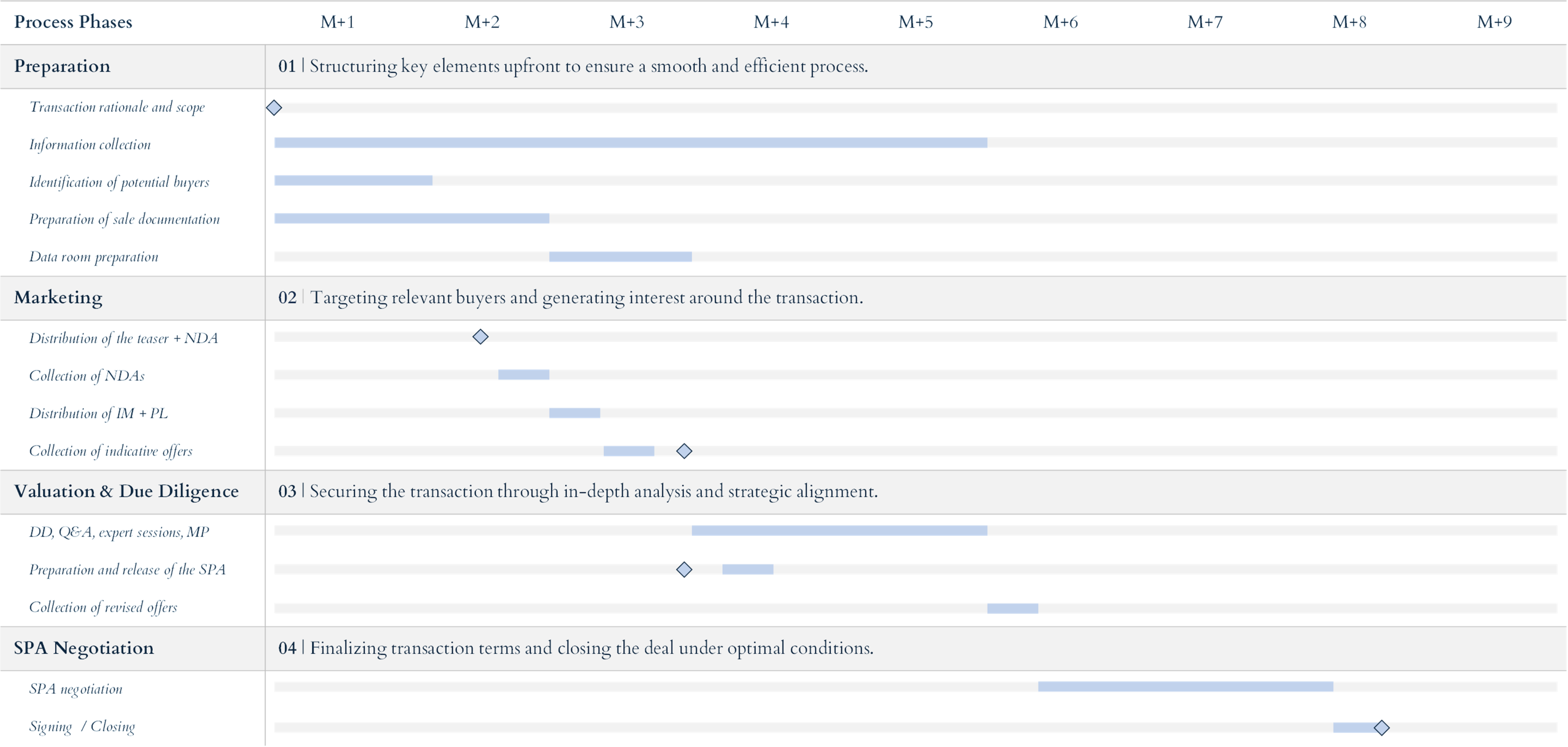
The preparation phase forms the foundation of the entire sale process. It generally spans one to two months, corresponding to the initial weeks of the indicative timeline. While not fixed, this timeframe reflects the time required to structure, in advance, the key elements necessary for a smooth and efficient process thereafter.
During this initial phase, the focus is first on clarifying the strategic rationale of the transaction and precisely defining its scope. This involves aligning the owner’s objectives, timing constraints, and the intended transaction structure. This step conditions the coherence of all subsequent phases.
At the same time, the collection and analysis of financial, legal, and operational information begins. This work makes it possible to identify the company’s strengths as well as potential risk areas likely to emerge during due diligence. The objective is not to eliminate risks, but to understand and manage them before engaging with potential buyers.
Preparation also includes an initial identification of potential acquirers, based on the company’s strategic positioning and market dynamics. This upstream reflection helps anticipate the marketing phase and avoid opportunistic or poorly targeted approaches.
Finally, this period is devoted to structuring the sale documentation and progressively setting up the data room. Although these tasks often extend over several weeks and may continue into later phases, anticipating them from Phase 1 is critical to maintaining the overall transaction timeline.
In practice, a rigorously conducted preparation phase significantly reduces process uncertainty, accelerates subsequent stages, and strengthens the company’s credibility with buyers from the very first interactions.
The Marketing Phase
The marketing phase typically spans one to two months, immediately following the preparation phase within the indicative timeline. It marks the transaction’s entry into the market, while remaining tightly controlled to preserve confidentiality and the seller’s command of the process.
This phase begins with the distribution of an anonymous teaser to carefully selected potential buyers. This concise document tests market interest without revealing the company’s identity. Interested parties are then invited to sign a non-disclosure agreement (NDA), a prerequisite for accessing detailed information.
Once NDAs have been collected, the information memorandum and the process letter are shared with selected buyers. This is a critical moment in the timeline, as it structures buyers’ understanding of the company and sets the framework for future exchanges. The quality and consistency of the information provided directly influence the credibility of the process and the level of buyer engagement.
The timeline then allows for a period during which buyers analyze the information and prepare their indicative offers. This sequence enables the seller to assess genuine market appetite—not only in terms of valuation, but also strategic vision and execution capability.
In practice, a well-paced marketing phase creates a controlled competitive dynamic, which is essential for value optimization. Adhering to the indicative timeline prevents process fatigue and maintains a high level of buyer attention, a key condition for entering the next phase under favorable circumstances.
The Due Diligence Phase
The due diligence phase generally extends over two to three months, forming the core of the sale timeline. It represents a pivotal stage, during which the transaction moves from an expression of intent to a detailed and structured analysis.
At this stage, selected buyers gain access to the data room and conduct their financial, legal, tax, and operational audits. This period is punctuated by regular exchanges, Q&A sessions, and management presentations, enabling clarification of uncertainties and validation of the assumptions underlying indicative offers.
The timeline also includes the circulation of draft SPAs and the opening of contractual discussions. Buyers then submit revised offers, incorporating the results of their analyses and initial adjustments relating to price, warranties, and conditions precedent. This phase progressively reduces information asymmetry and secures the transaction on objective grounds.
In practice, a well-organized due diligence phase, properly integrated into the timeline, helps avoid late-stage renegotiations and preserves the momentum created during the marketing phase. It is one of the primary levers for transaction security.
The Negotiation and Completion Phase
The negotiation and completion phase typically spans two to four months, at the end of the timeline. Its purpose is to convert the economic agreement into a binding legal commitment, while finalizing price determination mechanisms and the conditions for the effective transfer of ownership.
Negotiations focus on the final terms of the SPA, including price, representations and warranties, post-transaction commitments, and payment mechanics. At this stage, the choice of price mechanism plays a central role in the overall balance of the transaction.
Under a locked box mechanism, the price is fixed based on a reference financial position prior to signing. Cash flows occurring between that date and closing are strictly controlled, securing the price and limiting post-closing discussions. This mechanism is particularly well suited to companies with stable operations and strong financial visibility.
Conversely, under a completion accounts mechanism, the price is adjusted after closing, based on accounts prepared as of the transaction completion date. This approach entails a post-closing phase dedicated to determining the final price.
In practice, a well-managed negotiation phase enables the transaction to be completed under balanced conditions, aligning the interests of seller and buyer while ensuring a smooth transition into the post-transaction period.
The Indicative Timeline of the Sale Process
A Word from the Managing Director
The sale of a company is rarely a purely financial act. It often occurs at a pivotal moment in a business owner’s life, where economic, strategic, and personal considerations intersect. Behind the figures and contracts lie far-reaching decisions, sometimes irreversible, that extend well beyond price alone.
My role in this context is not to rush a transaction, but to structure each step methodically, enabling business owners to retain control over the process. A successful sale is one in which decisions have been anticipated, risks understood, and balances preserved. It is this discipline—far more than the final negotiation alone—that transforms an intention to sell into a controlled and successful transfer.
Conclusion: Selling a Company as an Exercise in Method and Clarity
The sale of a company cannot be reduced to a price negotiation or a succession of technical steps. It is a structured journey that demands anticipation, consistency, and rigor at every stage. From initial preparation to transaction completion, each decision influences the next and ultimately determines the outcome.
A well-executed sale reduces information asymmetry, secures the parties’ commitments, and preserves the value built over time. Conversely, a poorly prepared process exposes business owners to late-stage renegotiations, loss of credibility, and unnecessary delays.
Ultimately, the success of a sale depends less on finding a buyer than on the ability to orchestrate a structured, transparent, and controlled process. It is this methodological approach that allows for a balanced, sustainable transaction aligned with the seller’s original objectives.
Looking to build expertise in Mergers & Acquisitions?
Hectelion offers M&A training programs combining theoretical foundations, practical methodologies, and real-life transaction case studies.
👉 Learn more about the program
Author
Aristide Ruot, Ph.D
Founder | Managing Director

.webp)